

You Should Be Reading The Transformers Comics
The Transformers series has been a pillar of both pop culture and nerd culture since the 80’s. Though not the first transforming toys, Transformers lived up to their name in popularizing the gimmick, spawning plenty of copycats. To this day, Transformers has remained a huge staple of the pop culture landscape, with animated TV shows and various toy lines released often enough for every new wave of kids aging into the audience to have things to enjoy. Since 2007, we’ve even had a series of more adult-targeted live action movies that reinvigorated interest in the brand within the public eye.
But the whole time the Transformers brand has trucked along, there has been a silent juggernaut of the franchise going unnoticed outside of the eyes of a select few: the Transformers comics.
These Transformers comics began in 1984, produced by Marvel Comics, after Marvel’s previous success with Hasbro’s tie-in comics for G.I. Joe. These comics were treated as a part of Marvel’s larger superhero universe, to the point of even crossing over with Spider-Man in its 3rd issue. The actual first animated version of Optimus Prime, let alone any Transformers character, was in an advertisement for the Marvel Transformers comics.
These comics also set up some of the most interesting and simultaneously shocking moments in the whole series. Some of these moments include all of the Autobots being defeated and captured by the new Decepticon leader, Shockwave, and their bodies being hung up by their feet in the Decepticon base like slabs of meat in a freezer; Optimus Prime being decapitated so the Decepticons can extract the secret of creating new transformers from him, and the horrific moment where a teleporting accident fused the Autobot medic, Ratchet, with Megatron into a screaming mesh of melted metal.


These comics were foundational to Transformers as a series, Marvel writers actually being the ones to originally write much of the Transformers series’ story concepts. From names, locations, personalities, powers, down to the very concept of a conflict between the Autobots and Decepticons, alien robots stranded on Earth and battling for energy were all made by renowned Marvel writers like Bob Budiansky and Jim Shooter. The very identities of pop culture mainstays like Optimus Prime, Megatron, Starscream, etc., were all made by Marvel Comics writers and adapted into these comics. This was also where many core elements of the Transformers series began, such as Optimus holding a powerful Matrix relic or the transformers being created by a divine planet god, Primus.
In 2001, the rights to create Transformers tie-in comics moved to Dreamwave Productions, a smaller, since collapsed comic company. Their comics reinvigorated interest in the Transformers brand and comics after the fad and interest died away in the 90’s. They both created their own new series based on the original 80’s cartoon story but then moved on to create a series based on the (at the time) newest airing show, Transformers: Armada. Though using the same famous characters, both series went in the direction of creating wholly new stories separate from both series.
Unfortunately, Dreamwave was not built to last. The comics collapsed under debts, unpaid writers and artists, and some rather scummy business practices on the higher levels by 2005 — something that would retroactively form a sour reputation of the Dreamwave series and this era of the Transformers series. This is despite the fact that these comics played with and introduced many concepts that are now staples of the Transformers series such as the villainous Shockwave being a scientist, Ultra Magnus’ toy-accurate white form inside the armor, Optimus Prime once being a data clerk before becoming Autobot leader, and the first Decepticon, The Fallen. So even if the series did rather tragically break down right at the finish line, it does deserve its flowers.

One of the most popular series of Transformers comics was the product of IDW Comics. Their first run of Transformers comics began in 2005 and ran until 2018. This series, during its 13 year run, was directed fully towards adults and older teens, giving it the freedom to cover more intense and mature topics such as genocide, classism, police brutality, PTSD, the life of revolutionaries and war heroes during times of peace, redemption, fanaticism, religious devotion, and many more. This is not even to mention the list of characters IDW either created from scratch, or transformed from blankslate characters with barely a sentence of personality on their toy box, to some of the most impactful characters in the series.
These include but are not limited to: Tarn, the fanatical Decepticon so dedicated to the ideology and Megatron himself as to murder other Decepticons who don’t live up to such expectations, Sunder, the Autobot serial killer and cannibal who turns body horror into an art, and Cyclonus, a Decepticon out of time from when the title lacked such vile implications, who becomes a soulful warrior who will destroy himself to protect those he comes to love. Some characters were also utterly redefined, like Ratchet, Ravage, and Starscream, who have been around from the beginning but truly blossomed in IDW.
This is all not even addressing IDW was where we saw the first LGBTQ+ representation in Transformers. The most well known example of Cyclonus and Tailgate, people displaced in time and lost in the modern world, finding comfort in one another. Another instance being of Drift and Ratchet, older men with contrary religious views but similar compassionate souls. Of course, this also includes the groundbreaking Anode and Lug, the first lesbian couple and example of transgender representation in the series, who travel the galaxy as treasure hunters.
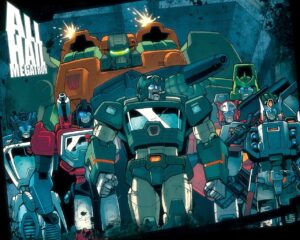
Though none of this came without IDW’s own growing pains, which is to be expected with so many writers penning for one world. One such growing pain is the infamous Spotlight Arcee, which revealed this universe’s version of the classic character to be a transwoman. But at the same time, it also painted the fact as horrific, unnatural, and fully against Arcee’s own will, being the reason Arcee in the series is a horrifically violent and brutal warrior. This would become something the rest of the universe would spend much time trying to remedy and retcon away. This could mainly be traced back to longtime Transformers writer, Simon Furman’s own beliefs on the transformer species’ relationship with gender that he carried over since working on the Marvel series.
But in 2018, the story of the IDW Universe transformers finally came to an end. The arcs and plots of many beloved characters came to a satisfying end as the greatest enemy of the Ttransformers, The Monster Planet Unicron, was put to rest. This brought the series to a close…
Until IDW Transformers 2: Electric Boogaloo!!
In 2019, IDW Comics began a new Transformers universe, one where they could tell new stories from scratch. This universe put much more focus on the time before the infamous Cybertronian Civil War, showing much of Cybertron’s society and who all our favorite characters were before they were hardened by war and diving much further into what made each of them who they are. We even meet the families of many characters, something not seen in previous comics. Megatron’s mentor, Termagax, even strongly opposes him after discovering what her mentee had become in her absence, while Optimus Prime’s mentor, Codexa, was the one to make Optimus the empathetic person he is modernly. This is along with many more stories of how the once prosperous Cybertron fell to ruinous civil war.
In 2023, IDW’s license on the Transformers brand ended, meaning so did their new universe. The torch was passed on to a new era of comics.
Now we come to Transformers’ modern and, some would say, most experimental comics made by Skybound Entertainment. This comic, part of what is known as the Energon Universe, named after the power source that gives the transformers life, is the centerpiece of the expanded universe that links several Hasbro properties together.
Skybound has instantly earned itself a unique name among Transformers series with its somber, dark tone and daring choices. It treats many characters as broken by the war on both sides, their planet dying like it’s never been portrayed before, and the transformers in abundance as an endangered species seemingly doomed to cause their own extinction.

Readers were shocked as the first issue proved this darker tone by killing fan favorite legacy character Bumblebee, the functional secondary mascot of the series, before he could even speak a word. He was shot in the head while still comatosed on the Autobot ship, the Arc, by Starscream. Many other famous characters, up until now treated as untouchable and required additions to any Transformer media, were brutalized and killed. Optimus Prime is treated as a worn down, tired man constantly second guessing himself. Once clearly empathetic and peaceful, he is now forced into committing atrocities by a brutal war. He even loses an arm in the third issue, getting it nearly blown off and then ripping it off himself to save an injured human from the violent Decepticon, Skywarp.
Now, in the year 2026, the Transformers comic series continues to grow in popularity. Skybound is getting many eyes on it from its daring choices and status quo shake ups. But even now, years after the end of the first IDW series, attention returns to it with new toys and fandom attention.
All of the Transformers comics are alive and well in their own ways, earning their place in defining the larger series.