

Tiny Bunny: When A Twist Makes A Story Worse
Everyone likes a good twist, right? It keeps you on your feet and paying attention. And when done well, it can elevate a story and let you see it in a whole new light when you return for a second viewing.
But in an inverse, a bad twist can sour a great story and turn repeat viewings into a miserable experience as you realize the act of being surprising was prioritized over telling an enjoyable story.
As a good bad example of this phenomenon, I offer up a recent personal disappointment: Tiny Bunny.
Tiny Bunny is an indie visual novel horror game by the Russian developer Saikono and published by Serenity Forge. It is composed of five episodes, being released from April 2021 to December of 2025. The game followed Anton, a 12 year old boy living in rural Russia during the late 1990’s, where after moving to a mysterious small village, he decides to investigate a series of missing child cases and the even more mysterious children wearing animal masks that live in the nearby forest.
Obviously, I will warn for spoilers of the game. As to explore its plot twists, I am going to spoil many of the 20+ endings of the game. And while I can’t give the game my personal recommendation, I don’t want to remove that choice from others.
This game was advertised to me as something of a somber, grounded horror game. The image I had in my head truly embraced the cold of Russian snow, making you feel isolated and powerless. Tiny Bunny pulled me in with its amazing hand drawn, sketchy black and white art style, charming voice acting, and brilliant music. Not to mention some characters (like Alisa) are beyond endearing. Its themes of the unaddressed horrors of being a child and the cycles of abuse had me intrigued and emotionally invested. Mainly through Anton himself and the four mysterious masked children he meets: Alisa the fox, Teddy the bear, Hooty the owl, and Wolfy the wolf.
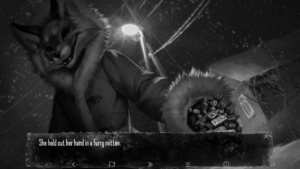
But in the last two episodes, the game decided otherwise.
In episode 4, we get the sudden reveal that the four masked children we’d gotten to know were in fact giant cannibalistic monsters with little to no personality. The game then makes a rather sudden shift from the previously grounded and quiet horror to suddenly a rather loud, in your face monster-horror as the previously very distinct personalities of the kids mesh together into the same “ooga booga, I’mma eat you and say scary stuff!” monster personality split between the four of them.
I think the core of the issue with the twist comes down to a few things:
- The non-twisted plot is more interesting than the plot twist
- The twist is full of cliches
- The twist makes the game too heavily diverge from the prior story
First off, let’s start with the twist being less interesting. Before the reveal that the masked children are man-eating eldritch horrors, they actually befriend Anton (especially Alisa who seems to harbor some sincere affection and a possible crush) and tell a story that they were actually children kidnapped by a still active murderer. Returning as fey-like perpetual children after death seemingly trapped by a Pied Piper-like figure. This story would seem to fit with the themes already set up in the game and would naturally lead to a nuanced ending where the player and Anton must choose either to endure unpleasant reality or give into the comfort of fantasy.
But that potential nuance was suddenly lost in place for the reveal that everything was just a lie. In fact, not a single thing we knew of these characters was the truth. Which functionally serves to remove the prior characters from the story as a whole and insert brand new characters in their place as we are reset to square one. During the climax, no less.
I’ll admit my next point is very subjective, that the twist is too cliche. But I will say that much of this ending relies on very wellworn concepts that make the twist and the story after rather uninteresting. We already addressed the monsters with very by the books personalities and vibes. But the Forest Master, a dreaded mystical force who is controlling the four kids, influencing Anton, and has been kidnapping children to feast on their flesh, is revealed to just be a very average looking goat demon. Something straight out of Spirit Halloween.
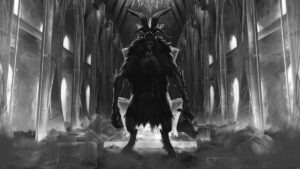
This just instantly drains any fear he might have inspired. Not to mention he spends some time pretending to be Russian Santa, “Grandfather Frost”. This is certainly meant to feel shocking, turning something innocent into something evil, but fails to land due to how often it has been done. Such as in Krampus (2015), Slay Bells (2020), Rare Exports: A Christmas Tale (2010), Santa’s Slay (2005), Etc. I mean what do you expect from a Santa in a horror game?
Alisa, basically the secondary protagonist up to this point, also falls into some unappealing tropes, becoming something of a fille fatal archetype for Anton, which certainly feels icky when the characters involved are meant to be roughly twelve years old, but Alisa also falls into the “Ambiguously Aged Child” trope, where it uncertain how long she has been in the service of the Forest Master and remained twelve. So much of her character can be uncomfortable, even moving past her strange personality shift.
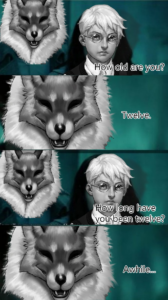
But the biggest offense I feel that the twist of Tiny Bunny commits instead comes from how it breaks the general tone and atmosphere of the game up to that point. Like I said, the first three chapters of the game dedicate much of their time to building up an atmosphere where a lot of the horror comes not from a big monster jumping at you, even if there are jump scares, but more so from the eerie silence, isolation, and powerlessness you feel both in the frozen streets of rural Russia and within social situations. Anton has no power socially or physically: defenseless.
Something that feels like a rarer form of horror, especially as it made the warmer moments feel so much better. Alisa comforting and grounding Anton after he got scared or Anton playing with his sister feels so much more rewarding when you know he has no ability to defend against the other horrors in the woods or stop his parents from fighting in the next room over.
But that tone of quiet, aching horror is lost almost immediately as the game makes a shift towards much more direct horror through big monsters and gore. Which, paradoxically, makes it less scary. Walking through the forest alone with the sense that I am being watched is so much more scary than staring up at a big monster Alisa with bug parts saying she’s gonna eat me.
This is not even mentioning the greatest tone shifts, the 20+ endings. These endings become utterly insane: Revealing the whole game as a schizophrenia hallucination by Anton, Anton and Alisa dying in space after trying to jump up and eat the moon, the appearance of a biblically accurate angel out of nowhere with no followup information. Even to the ending that has become an utter meme between my friends and I: the Kaiju Ending, where Anton joins the monsters and they all become giant kaijus who eat all of civilization before moving on to devouring the whole universe, planet by planet. How you ask? A ritual. A ritual the Forest Master just knew…
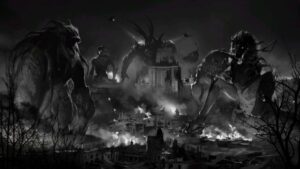
Something that I can’t even begin to discuss in any reasonable fashion.
Really, I think Tiny Bunny gets to the core of what a bad twist can do to a story. The game began with nuance and subtlety with a unique atmosphere, and was very much on track to becoming one of my favorite games of all time. But then it gave all that up for a few cheap scares that make me unable to even touch the game again. Which is in spite of the utterly wonderful art, music, and voice acting that I will be taking notes of even though they were undeserving of this story.
Obviously, a lot of my feelings on this game are subjective. I simply think Tiny Bunny lost more than it gained through the choices made in its narrative. There was a solid amount of potential in the first few episodes, but possibly due to the time between episode 3 and 4’s releases, being about a year and a half followed by another two and a half for episode 5, we lost that.
Maybe, at the very least, we can learn from the mistakes of Tiny Bunny when it comes to writing twists. And my fellow artists may take some notes from this wonderful art.
I mourn what Tiny Bunny could have been…