

Requiem for a Scream: An Ode to Resident Evil and B Movie Horror
What really makes a Golden Age? Resident Evil is arguably in one, and with the 9th mainline installment in the video game series, Resident Evil Requiem, releasing this week, expectations and the number of eyes on the series have really never been higher.
It most certainly was not always like this, though, but I’m getting ahead of myself.
Resident Evil (or Biohazard in its country of origin, Japan) is an almost impossibly large series to try and capture with any true appreciation for its breadth and influence. In the just under 30 years since the first game’s release in March 1996, Resident Evil has seen the release of dozens of video games on nearly every platform, film spin-offs, TV series, and collaborations that range from small merchandising to major crossovers with other video game developers.
It’s often credited as the progenitor of modern Survival Horror, in the same way that Doom, Quake, and Halo are credited with the First Person Shooter, Dragon Quest and Final Fantasy are credited with the JRPG, and Mario is credited with the Platformer. Sure, other major Horror games preceded Resident Evil (Clock Tower, Castlevania, Alone in the Dark), but none distilled and subsequently popularized “Survival Horror” on a global scale like Resident Evil did (or, really, does).
Out the gate, Resident Evil introduced mechanics that would become mainstay staples not just of its own series, but shorthands for future games in myriad genres. The Green Herb to heal your character after taking damage, Ink Ribbons to save your game progress, two protagonists who each play differently and have different story beats, cinematic fixed camera angles, the now-infamous “tank” controls, a host of horrific virus-laden undead monstrosities waiting around every corner—almost every element of this first attempt became instantly iconic and equally as recognizable across the industry.
Resident Evil was a near-universally beloved Survival Horror on day one and would be the reason future Survival Horror icons like Silent Hill and The Last of Us even exist at all.
There was just one little thing…
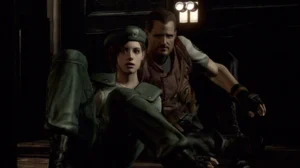
Resident Evil isn’t scary. Like at all. It’s hilarious.
Campy horror is probably the first identifiable genre I was able to express my love for as a kid. Sure, I loved all kinds of fiction from the fantastical to the futuristic to the TeenNick soapy rom-dramedies—but over-the-top, cheesy, camp-filled “horror” was the first tangible, definable genre of anything that I fell in love with.
I was the kid who read through every R.L. Stine novel in my elementary and middle school libraries at least twice before trying to read the books any of my friends were drawn to. I watched slasher flicks with my friends’ older siblings or at my cousins’ house to skirt around my parents’ strict, religious objections.
The one and only time I was allowed to watch a “real” horror movie as a kid at home was the night before Halloween at an age where I still had baby teeth wiggling their way out. I watched Evil Dead 2 with my best friend in my living room and had never laughed harder in my entire life to that point.
There was something about the fusion of the horrific with the comedic (the comedic that often straddled the line between “intentional” and “accidental”) that was just relentlessly compelling to me from as young as I can remember.
The one exception to my favorite fictional genre was, ironically, video games.
There was something about the agency of a video game that created a wall for me. Despite loving video games of every other genre that I’d played and loving horror in every other medium, horror games filled me with this deep fear that was hard to articulate and harder to overcome.

Every effort I made to delve into the world of horror games did not go well. When I tried to play Amnesia with the same friend with whom I watched Evil Dead 2, I started crying as soon as I started getting chased. When my brothers tried to get me to play COD Zombies with them, I could only stand with my character’s back against a wall and cried when I had to run from the monsters. When Five Nights at Freddy’s hit the scene, I tried to play the first game. After being jump scared for the first time, I, you guessed it, cried.
Some fight or flight (or, uh, cry) response seemed to trigger at a deep, biological level every time I had agency in a horror experience. It just completely paralyzed me.
So, I basically gave up on trying. I grew up, still engaging with horror in every non-video game form, and resigned myself to the idea that the medium of video games would forever be an inaccessible way to experience horror.
Resident Evil, too, seemed to give up on horror for a time. Despite spending much of its first ten years perfecting the Survival Horror formula, even going so far as to be genuinely terrifying at moments instead of just funny, RE began making the slow but steady shift toward Action beginning with 2005’s Resident Evil 4. RE4 was met with universal praise and is still the most critically acclaimed game in the series, but it was also noted for its (at times) over-the-top silliness and major break away from the horror roots that had defined the series up to that point.
It was beloved, but it also marked a turning point that almost killed the series.
Resident Evil 5 and 6 went full steam ahead into Action Horror instead of Survival Horror. The existing characters, while never overly serious, were flanderized and/or jumped the shark completely into action movie hero status. The games were poorly received and, despite a recent online push to recontextualize them as excessively maligned or even good, they’ve never really been grouped into lists of “the greats” where mainline RE titles are concerned.
2012’s RE6 in particular was feared to be the death knell for the series. Releasing around the same time as the poorly received Silent Hill: Downpour, a game that would mark a decade long drought in its series (especially after the well-publicized cancellation of P.T.), Survival Horror as a whole was broadly considered a dying if not already dead genre for mainstream video games.
The Last of Us in 2013 was one exception to this rule, although its heavy narrative focus and more prominent action elements left many fans of traditional Survival Horror games arguing that it didn’t really count as one.
(It totally, absolutely, assuredly does, but that’s an argument for a different time).
By and large, Triple A horror games were in a lull during the mid 2010s. Indie giants, such as Slender and the aforementioned Five Nights at Freddy’s largely filled the void popularly, but blockbuster horror experiences weren’t really happening as they had before.
In 2017, I was in high school. I still hadn’t really engaged with horror games in any real capacity, though I was consistently recommended games like The Last of Us or Outlast by friends based on my interests.
It still seemed like too much for me, though. Not being able to play horror video games had stopped being just a descriptive acknowledgement and instead had become a prescriptive feature of my personality.
Still, I did end up giving The Last of Us a try a few years later. Despite being dismissed as not “really” a horror game by many horror aficionados then and now, it was absolutely terrifying for me, taking multiple attempts and many weeks to complete. The incredible narrative and heartbreaking story hooked me and wouldn’t let go, but the misery of the horror-filled play experience turned the game into the exception that proved the rule:
I could not play horror games.
Something else was going on in 2017, though. After five years, the longest stretch between mainline Resident Evil games to date (assuming you count Zero, at least), a new game was finally coming.
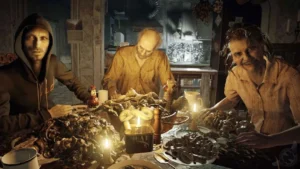
RESIDENT EVII. biohazard (BIOHAZARD 7. resident evil in Japan) was pitched as a return to form. Hell, even the title was a melding of its two national identities. It was a return to Survival Horror in a way that developer Capcom was really trying to push. They knew just how much was riding on this one last chance to reclaim the series’ identity and bring RE to a new generation of players. To that end, Capcom also developed an in-house, bespoke engine for development called the RE Engine.
They went all in on this game.
I won’t beat around the bush here. RE7 smashed expectations and became one of the most highly regarded games in the series. It was also truly, genuinely, terrifying.
To say that RE7 was a return to form is to misconstrue the form that RE had taken prior to this point. Even at its scariest, there were unbelievable levels of camp (“Jill sandwich” and “Where’s everyone going, bingo?” anyone?). It could be atmospheric, suspenseful, and scary, sure, but nothing, and I mean nothing in the series could have prepared people for RE7.
Resident Evil VII took inspiration from my favorite childhood horror series, Evil Dead, and stripped back the action-packed, super-cop presentation long dominating the series to reveal something grounded and uncanny. It’s set in a farm estate in the bayou of Louisiana, with a civilian in search of his missing wife as the protagonist and a moldy, dilapidated farm house with the equally mold-infected Baker family inside.
There were no city-wide zombie outbreaks, super secret special missions to rescue the president’s daughter from a foreign country, or helicopters grinding on the side of a moving train here. It was small and recognizable and horrifying for it.
And this small, intimate scope was exactly what the series needed. In the years since, we’ve received (mostly) well received remakes of classic games RE2, RE3, and RE4, as well as VILLAGE, the eighth mainline entry. Every game since RE7 has used this basically magic RE Engine to blow people’s expectations out of the water.

RE7 turned out to be exactly what the series needed. Nowadays, Resident Evil is spoken about with adoration first and expressions of genuine terror on the forefront of every player’s lips. The upcoming RE9, Requiem, seems poised to keep this trend of love going. It’s set to release February 27, right on the cusp of the series’ 30th anniversary. According to marketing so far, it features fan-favorite character (and protagonist of many of the best-received games in the series), Leon Kennedy, pairing up with newcomer Grace Ashcroft, daughter of a spin-off character from a game way back in the early 2000s.
None of this, none of this renewed love and shift to genuinely terrifying horror, would have been possible without RE7.
Even so, despite being inspired by Evil Dead in maybe too many ways to even count, RE7 is far more horrific than the campy B movie disaster that I loved as a kid. I heard about the game at the time, along with its inspiration, so I bought it.
After being too scared to even walk up the Guest House stairs about 4 minutes into the game, though, I put it down and figured I’d just never actually touch this series. The Last of Us proved the rule, after all.
Except, maybe it didn’t.
If it isn’t obvious by this point—and if it isn’t, I’ve done a terrible job with this piece—I absolutely adore Resident Evil. Hell, in preparation to even write this piece, I went back through all five of the RE Engine games and had a blast with them.
So, what happened? How did I go from being too scared to even take a step in RE7 to being a die hard fan?
Well, I’d like to credit Evil Dead—not in the way that the RE developers did, though. Or at least not for the same game that they did.
Since the first time I froze up and cried in a horror game as a young kid, I’ve been looking for an “in” to horror video games. I wanted to find a way to experience them, to love them the way I did horror in every other medium of fiction.
An off hand comment from a friend of mine years ago, referring to Resident Evil as “silly,” perked my ears up. I had only ever really looked at RE7, a consequence of it being so popular, and RE2 Remake, which featured claustrophobic hallways in a dimly lit, zombie-infested police station that seemed quite a bit less than inviting. How could this series be silly?
I needed to find out, obviously. And really, what was the harm in buying another video game that I was likely to drop within 10 minutes of starting it anyway?
So I picked RE3 Remake on a whim and bought it. I was terrified in the beginning, just like I figured I would be. Being chased by a big scary monster—Nemesis—through the streets of Raccoon City overflowing with the undead was almost too much for me. I was about to give up on it, accepting for the millionth time that horror games just could never be for me, when I got to the roof of a parking garage in the game.
Something changed here.
Protagonist Jill Valentine, on top of this roof and being chased by an unyielding monster sees a car. She yanks the corpse behind the wheel out of it, apologizing as she does so, and jumps in. This could be her out. She tries the key.
It won’t start. Nemesis is getting closer.
She tries again.
It won’t start. Nemesis is getting closer.
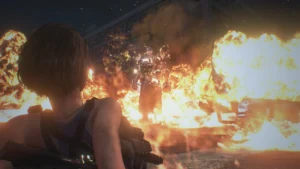
She tries to start the car one more time and the engine hums to gurgling, tepid life. I’m terrified. I feel like my heart is about to croak out on me from the suspense. Jill yells, “It’s my turn, bitch!” and slams on the gas. She crashes into the monster and drives them both straight off the roof of the parking garage.
Inexplicably, both survive. Jill fights her way out of the burning car, backing up from the ever-approaching Nemesis, seemingly unfazed despite it all. Is this the end?
No. Secondary protagonist Carlos makes his introduction by yelling, “Hey, fuckface!” and shooting Nemesis with a rocket launcher.
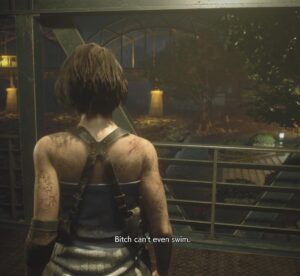
Oh. Oh.
It clicked. Resident Evil was silly. That whole sequence was ridiculous. It was scary and tense but it was oh so unserious. Like cherry Kool-Aid colored blood bursting through the wall in Evil Dead 2, RE finally managed to be scary and funny at the same time.
I loved it immediately. I know that 3make is largely maligned as the worst game in the series since RE7, and I would probably agree all things considered, but it did something for me I never thought a horror game would literally ever be able to do.
It gave me my “in.”
I took that and ran with it. I played the RE Engine games, I went back to the older ones, I started playing the low-rated co-op games; I completely devoured Resident Evil and then moved onto other horror games. I was able to buy and love Silent Hill f last year, expanding well past campy horror and into something deeply terrifying and disturbing.
I couldn’t get enough of horror games. Finally.
During Capcom’s spotlight for upcoming games in June 2025, RE9’s director Koshi Nakanishi described the core concept of the upcoming Requiem to be “addictive fear.” He, along with his team of developers, had worked to perfect terror, though I believe they’ve had that accomplished for years. They build horrific experiences in ways that terrify players but keep them crawling back for more. They pace games in a way that feels like overcoming serious, scary odds, getting brief reprieve, and then wanting to go back for one more hit of that feeling of accomplishment. They embrace the agency that playing through horror can give and make it something that feels good.
And finally, I can agree and say that it does.