
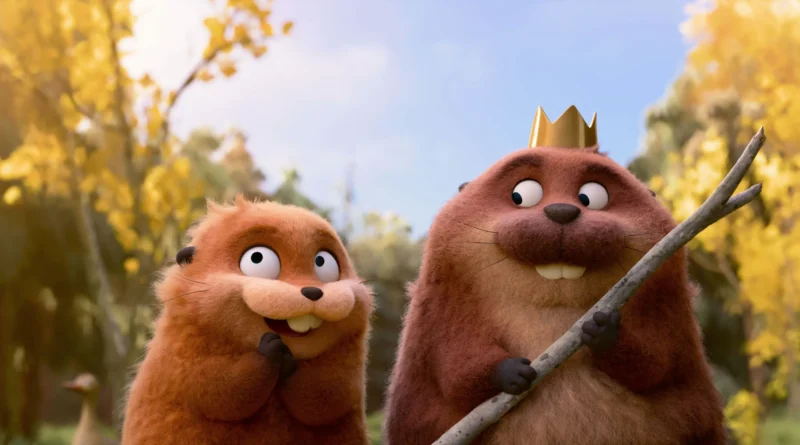
Hoppers Hot Takes
Disney Pixar’s Hoppers debuted in theaters this past March, and — once again embodying my inner Disney-freak — I was able to watch it over my university’s spring break. I hadn’t gone to the movies since I saw the wickedly-dark Avatar: Fire and Ash (2025) in December. I also hadn’t seen a new Pixar movie since Elio (2025), so I was excited to see the studio’s new addition to its line of projects.
My excitement was rightfully felt. The story had an environmental focus, a “save the wildlife” call-to-action unlike its older sister films (unless you count UP (2009). The animation blended naturalistic profuseness with computer animation, advancing Disney Pixar’s aesthetics, and the cast featured many notable names, including SNL alum Bobby Moynihan and three-time Academy Award winner Meryl Streep. The film also continues Disney Pixar’s trend of using quirky humor to appeal to an array of audience demographics, particularly younger age-groups (though I’d argue that the jokes landed more with Gen Alpha).
Nevertheless, my excitement was tinged with disappointment. Not a massive amount of disappointment — just enough to compare it to recent films like Inside Out 2 (2024) and Elio (2025) and say to myself, It could’ve packed a larger punch. For days, I had trouble articulating why Hoppers didn’t scratch my itch, but after some thinking, I finally found the right phrase to capture my slight dissatisfaction:
It felt like a repeat of other Disney/Pixar stories in a different font.
I’ll begin with its premise: A passionate conservationist named Mabel (Piper Curda) is fighting her town mayor, Jerry Generazzo (Jon Hamm), on his initiative to destroy the unpopulated glade she and her grandma, Tanaka (Karen Huie), used to go to and observe wildlife. While attempting to lure a beaver to the glade to seize a life-or-death reason to stop the destruction, she discovers that the beaver isn’t a regular rodent. It’s a “Hopper,” a robot controlled by human consciousness, invented by Mabel’s biology professor, Dr. Sam (Kathy Najimy). Mabel body-hops into the manufactured beaver without Dr. Sam’s permission, taking it upon herself to draw the beavers back to the glade and prove to Jerry that there are animals living in the area.
However, this hijacking comes with an awakened awareness of the animal kingdom. Through her robot eyes and ears, Mabel discovers the glade’s social functions: bugs, birds, beavers, and other species coexist together, forming factions and hierarchies within the realm. And like in perfect human-made societies, there are rules that the animals follow to keep the ecological balance, well, balanced. “Pond Rules” is what King George (Bobby Moynihan), the leader of the mammals, humorously refers to them as, which consists of three points:
- “Don’t be a stranger.”
- “When you gotta eat, eat.”
- “We’re all in this together.”
Mabel’s new sense of the animal order, her hyper-need to advocate for her furry friends, and her efforts to hide her human identity from the animals mess with her initial plan in saving the glade and creates more violence in her environment than ever before.
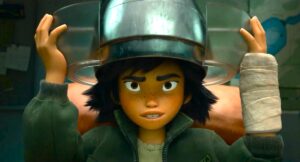
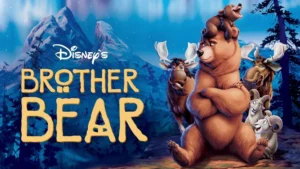
Even though I don’t consider wildlife conservation to be my biggest mission in life, I can appreciate a Pixar movie using the cause as the beating heart of its story — especially since it resonates with current environmental issues. This and its sci-fi atmosphere are what make the film itself unique. I can additionally appreciate animals being personified as leaders and good samaritans in animated movies. Not only does this make audiences appreciate wildlife, but it also expands people’s childlike imaginations of the worlds they can’t see. At the same time, though, I feel like Hoppers shares many of Brother Bear’s (2003) “quirky animal concepts,” which, oddly enough, doesn’t give me warm fuzzies as a Disney nostalgia-chaser. Instead, it only bored me.
Brother Bear (2003) is a phenomenal watch, however, it’s more spiritual-based. Through the music of Mark Mancina and Phil Collins, it follows the story of an Alaskan tribesman who turns into a bear after killing the Kodiak that caused the death of his brother. The animals in this film exhibit distinct human expressions: they joke, they form communities, and some even speak in Canadian accents. The animals in Hoppers express similar behaviors through their initial interactions with Mabel and their Pond Rules. The protagonist in Hoppers even becomes a forest animal and befriends an animal of the same species like the protagonist in Brother Bear (2003). But when the subject of playing with nature is mixed with killer emotional premises in films like the unsung 2003 classic, it is hard copying that recipe without appearing unoriginal or missing an ingredient.
The missing ingredient in Hoppers is its reason to care about its characters, its emotional draw — and at the end of the day, that is what makes this story feel a bit like a copycat drag. I simply don’t know enough about some of the main characters to feel drawn to them; I want more meat on the bone.
Grandma Tanaka comes to my mind the most. If there is an emotional foundation to this story, she is the sauce: she instilled in Mabel the passion of protecting natural habitats and their inhabitants, forming her fervent characteristics in the long run. She did this by showing her the beauty of their environment when she was young, framing their surroundings as peaceful mind-grounders. Introducing Grandma Tanaka at the start of the film is a smart plot choice, and having her act as a practitioner of nature-infused mindfulness does provide context to Mabel’s roots — enough context to keep my eyes open in the movie theater, at least. But I do think her scenes felt too fleeting for me to sink my teeth into her dimensions as well as Mabel’s. Especially since her character journey gets cut short by death in the very beginning.
I just want to learn more about this lady!
Whenever I think of Grandma Tanaka, I compare her to Bing Bong (Richard Kind) from Inside Out (2015) and Tadashi Hamada (Daniel Henney) from Big Hero 6 (2014). Sitka from Brother Bear (D.B. Sweeney) is additionally called to mind. The four of them share these commonalities: premature deaths, positive complexions, and abilities to mold their fellow protagonists for the better. These similarities are clear as day, and they do establish emotional foundations that pull watchers in. But since Bing Bong, Hamada, and Sitka have way more dialogue and slower-paced screen times, I am able to not only invest in them as characters, but also in their fellow protagonist(s). Let’s just say that I needed more time with Grandma Tanaka to see her as more than a grandma, and to see Mabel as more than a fiery wildlife conservationist.
I am not denying the fact that Hoppers has something important to say. I am also not denying its funniness and charm. I feel like this film will be a classic in ten years time. Just check out its Rotten Tomatoes score — it’s popping! But what I am expressing is that the movie’s pacing could have been slower, and in return, could have dove into more diverse character concepts. This could have made Hoppers not only unique in itself, but also more memorable in my book.
