

Toeing the Line Between “Drama” and “Disrespect”
Mild spoilers ahead!
When I first heard about The Drama, I had no idea what it would be about — my best friend sent me advertisements from A24 that set the vague impression of an artsy rom-com, and so that’s where the movie slotted in my mind. An engagement announcement in the Boston Globe, Zendaya showing up at a Vegas wedding chapel, and the release of a fully-functioning RSVP site all set a distinctive tone beside a trailer that didn’t reveal much of the plot’s actual substance, choosing to keep its twist hushed until viewers could see the movie in full.
A few days before its release, my best friend sent me something else: an article from TMZ that the film had been condemned by the parent of a Columbine victim, and a subtweet asking “what the fuck is this movie even about?”
After watching The Drama, I don’t think it’s much of a spoiler to say that the film isn’t strictly a romantic comedy; it leans into darker tones and finds both humor and intrigue in making audiences marinate in their own discomfort. It takes deeply serious topics and explores them from angles not typically thought about, creating something that is (if nothing else) thought-provoking. I don’t find it a stretch to say that there was a gap between what the film is and what it was advertised as, nor a stretch to say that this was an intentional choice for the artistic experience.

The Drama is by no means the first movie to do this — maybe the most iconic example is 2005’s Brokeback Mountain, which advertised a “universal love story” and focused on emphasizing its critical acclaim and positive audience reception, often choosing to gloss over the fact that the love in this story was between two men. This let the movie gain a larger audience than pigeonholing itself into the (at the time small) niche of gay romance would have allowed. It also surprised audiences, putting them in the shoes of Heath Ledger’s character on a first watch and letting them pseudo-experience the shock of his awakening. Although both of these films’ marketing campaigns were deeply intentional and effective, one key element separates them:
There’s a bit of a difference between the taboo of queerness and the taboo of gun violence.
Tom Mauser — the parent interviewed by TMZ — finds his own critiques in the fact that discussions of mass shootings shouldn’t be “used for entertainment” in the context of romantic comedies, and it’s difficult to disagree with someone who’s been affected by these tragedies in the way he has. Watching the movie, it’s pretty apparent that writer/director Kristoffer Borgli isn’t American: Gun violence is discussed in a way that caricaturizes reactions to cater to outside perspectives, almost mythologizing these disasters in the process. He attempts to portray the American fascination with and fetishization of violence and weapons, although he places his focus on individual circumstances and stops any analysis of wider sociopolitical dynamics or histories simply at their existence.

While The Drama makes for a well-crafted film that snapshots complicated, entangled feelings like debating the conditionality of your love for someone or the self-centered shame surrounding who you used to be, its aim to focus on such a heavy topic like gun violence without having anything that feels substantial to say can read as insensitive or almost opportunistic. The film has characters who are deeply complicated and fascinating to follow, grappling with the turbulence of their pasts, presents, and futures all at once — but this is only able to happen at the expense of real people who live in fear, or those who have been unfortunate enough to be affected by these tragedies.
As someone who was directly threatened with gun violence when I was in school, I don’t think that these themes should be off limits for exploration, nor do I think someone has to handle them perfectly for the product to still be considered a “good” piece of art — however I think that exploring these topics should come with a respect for your audience that doesn’t place a creative vision over the dignity of such a tragedy’s victims. This movie is incredibly well-made and visually conveys emotion in an extraordinary way, but its choice to completely launder such a loaded topic in its marketing is one that I can’t help but keep circling.
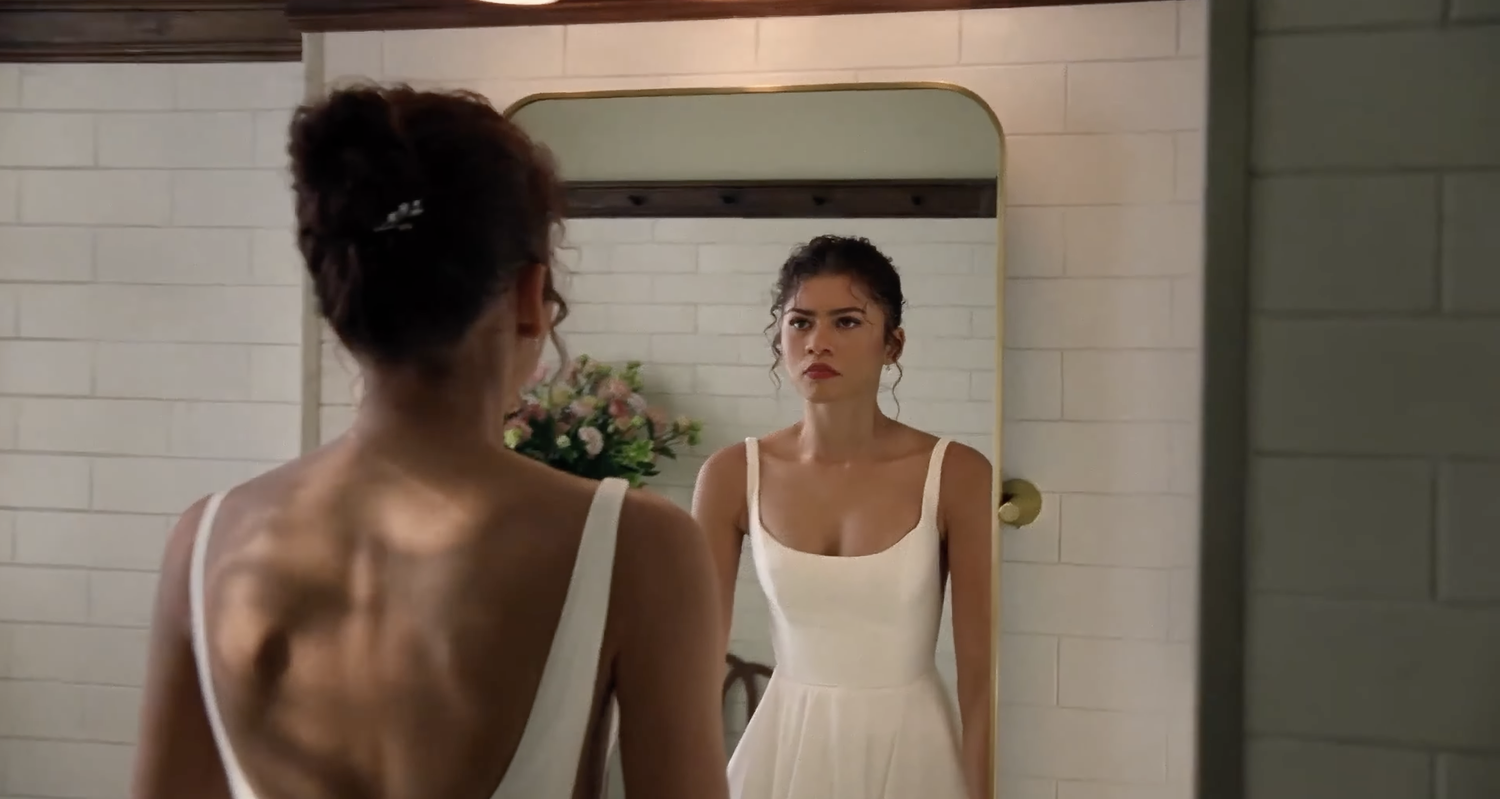
I understand that, to some people, spoilers are the thief of joy — especially in the current state of the film industry. So many movies are fun on a first watch while you’re unsure what’s coming next, but an over-reliance on plot deviations can lead to other aspects feeling underdeveloped (characters, narrative cohesion, etc.). Having this kind of film spoiled can, in turn, spoil the entire appeal of the movie. But The Drama is not this kind of movie.
I personally went into the theater with as many spoilers as are included in this article, and still found the hour-and-three-quarters invigorating. While I don’t think it has much to say about gun violence, it has a lot of other things which it conveys incredibly well and which have been utterly stuck with me in my week since watching. There’s no undoing the marketing campaign, but there is something to learn from how it was handled: Advertising a movie like this may result in higher first-week sales from an audience otherwise uninterested in the premise, but it’s also a decision that can find itself marked somewhere between “irresponsible” and “unethical.”
The Drama is currently available for viewing in most theaters.